





Key takeaways
The Apple TV glass intro and Coca Cola’s AI holiday ad are NOT PROOF that “AI ads do not work.” They are proof that intention, taste and emotional clarity still decide how work lands. When you treat AI as a production shortcut, the ad looks and feels like a shortcut. When you treat it as a way to remove friction around a strong idea, it lets more people make work that feels crafted without needing Apple or Coca Cola budgets.
Over the last few weeks, two pieces of work have been passed around every marketing group chat.
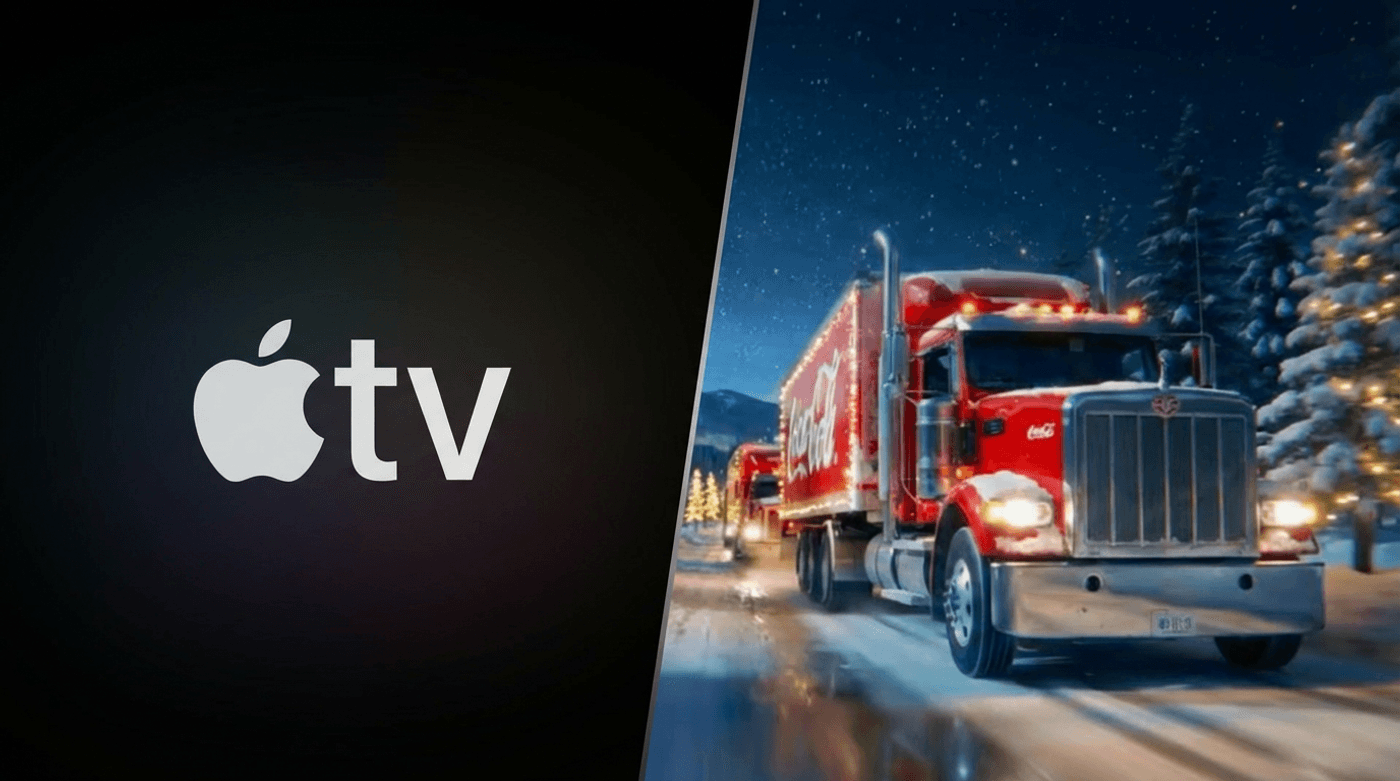
On one side, Apple’s new Apple TV intro. A few seconds of a glass logo being formed in camera. Real materials, real lighting, weeks of design and engineering poured into something most people skip. The story that travelled was not just the frames themselves, but the making of these ads. People shared the behind the scenes because it felt like Apple doing what Apple does best. Overbuilding the details that nobody asked for.
On the other side, Coca Cola’s latest AI powered holiday ad. Red trucks moving through snowy landscapes. Technically sharper than last year’s attempt, but still full of small tells. Shifts in style, shots that feel rendered rather than photographed, a sense that you are looking at an echo of that one ad everyone remembers rather than a new chapter. The internet labelled it “soulless.” Comments were turned off. The conversation moved from Christmas to cost saving.
The easiest way to frame this is “AI bad, physical good.” It feels neat. It flatters our fear that machines will flatten everything. It lets us say the work failed because of the tool.
At invideo, we do not buy that story.
We believe the real difference is not camera versus model. It is whether someone protected the idea, the emotion and the details all the way through.
The false comfort of AI versus craft
It is comforting to imagine that the world split neatly into two kinds of brands.
On one side, the patient, handcrafted purists who do things “the right way.” On the other, the lazy, AI fuelled cost cutters who care more about efficiency than feeling. When you look at the Apple TV intro next to Coca Cola’s AI trucks, it is very tempting to fit them into those roles.
The problem is that this lens does not help you make better work. It only lets you judge work that is already finished.
If you are a founder, marketer or creative lead, you do not wake up with the choice “analog or AI.” You wake up with harder questions.
What matters enough to overbuild?
Where to move fast and test?
What to hold the line on when you are under budget pressure?
Whether to run another experiment or bank a simple, solid story that people can understand?
In that reality, the question “did you use AI?” is almost never the most important one. The more honest question is “did you think hard enough before you touched any tool at all.”
What the Apple TV intro really does
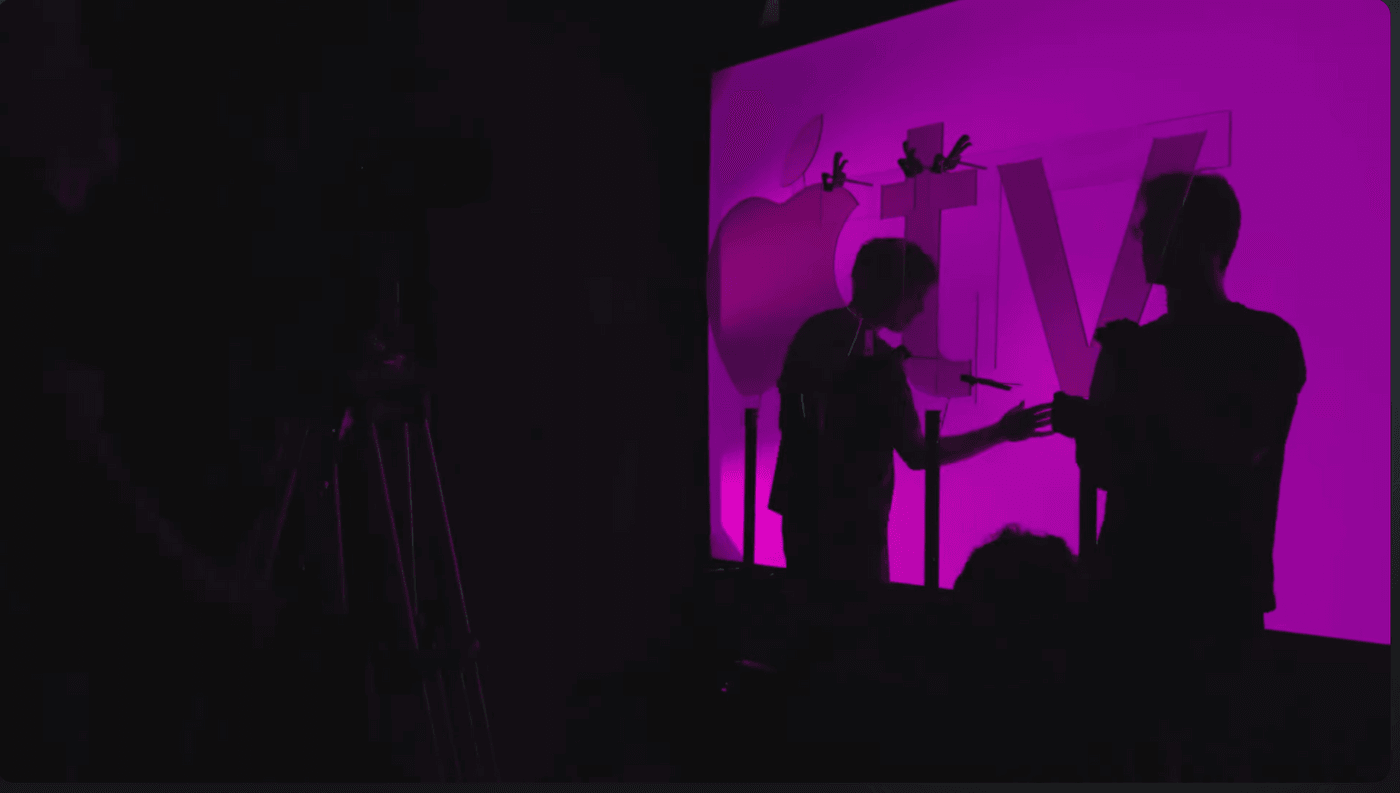
Apple could have made a perfectly clean CG version of that glass ident. No one would have complained. Many people would not have noticed.
Instead they committed to something deliberately inconvenient. Physical glass builds, complex lighting rigs, and a whole team working for weeks on a few seconds you can skip with a button.
That choice does two things at once.
First, it reinforces the story Apple has been telling for decades. We obsess over things you do not see. We sweat the tolerances. We over design the parts that are technically optional. The intro becomes a little proof of that belief. You do not even need to see the making of. You can feel that this was not the cheapest way to get there.
Second, it gives creative communities something to rally around. Designers and filmmakers share the piece not because it is useful, but because it is a statement. It says “we still value the craft itself.” The medium is part of the message because it is in sync with the brand.
The important point is this. The intro works because the craft serves a clear, consistent story about Apple. Not simply because there is no AI involved.
What Coca Cola’s AI holiday ad is really signalling

Coca Cola does not just sell a drink in December. It sells a ritual. For a lot of people, those trucks have marked the start of the holidays for years.
When a brand sits on that kind of equity, the job of each new chapter is delicate. You can modernise the look. You can move from film to digital. You can add surprising twists. What you cannot do is lose the feeling at the centre and hope no one notices.
In the recent AI holiday spot, you can see the ambition. The trucks are back. The snow is there. The animals and scenes are more technically polished than the first AI version. The wheels move properly. The lighting feels more coherent. On paper, it is an upgrade.
Yet the response has still been cold.
Viewers describe it as an imitation of nostalgia rather than nostalgia. They pick up on the inconsistent styles between shots. They talk about how it looks like a render rather than a memory. They do not feel the warmth they associate with the older work.
This is not about people hating AI in principle. It is about the signal embedded in the decisions.
When a brand that once spent real money and real time crafting human stories around those trucks now hands the moment to a generator and lets obvious slips through, the message is simple. This is good enough. The ritual is no longer worth the same level of care.
People are not punishing Coca Cola for touching AI. They are reacting to what the finished ad says about how much the brand still values the moment.
The quiet truth behind every great ad
If you strip away the hype and the tools, strong ads are built on a handful of quiet choices. They look different on the surface, but the bones are almost always the same.
-
1.
Decide who you are really talking to
The first decision is not about cameras or models. It is about one person and one situation.
Are you speaking to a tired parent who wants dinner to be easier without guilt. A small business owner who thinks video is out of reach. A driver who needs their car to feel like a reward, not just a purchase. A young artist queueing up playlists in the background while they work.
Apple’s intro feels like it is talking to people who notice details and value the craft of storytelling. People who enjoy the friction of something made. Coca Cola’s AI trucks feel like they are talking to everyone and no one. When you talk to everyone, you usually end up with a generic story that nobody feels is truly for them.
-
2.
Choose one feeling to protect
Great work tends to be built around a single dominant emotion. Relief. Wonder. Pride. Mischief. Tenderness. Ambition.
The more clearly you can name that feeling, the more every decision becomes easier. Does this shot support it? Does this line of VO enhance it or dilute it? Does this music cue match it?
Holiday work is especially sensitive to this. If you want to trade on nostalgia, you need to anchor it in a very specific human moment. A sound, ritual, or a small behaviour you recognise.
Apple’s intro is narrow and sharp. The feeling is admiration. You are supposed to think “no one else would bother doing this.” Every frame leans in that direction.
Coca Cola’s AI ad tries to gesture at many feelings at once. The result is that none of them land fully.
-
3.
Write a script that would still work on radio
It is easy to fall in love with visuals, especially when AI can give you incredible frames with a few words. The trap is assuming that beautiful images will build meaning on their own.
A simple test we use internally is this. If you played the script as an audio only spot, would it still make sense. Would someone still understand who this is for, what is being promised, and why they should care.
Many of the AI ads that feel “soulless” fail this test. If you strip away the generated imagery, you realise there is no real story. Just a sequence of shots chasing a mood.
In contrast, think about a strong promo you can build with a text to video engine like invideo’s AI video generator. If your script clearly introduces a character, a tension and a payoff, the visuals have something to work for. If the script is a vague voiceover about “innovation” and “the future,” no amount of lens flares will save it.
-
4.
Make the product the proof and not the background
People do not remember your production method. They remember what the ad proved to them.
If your video is about a car that can live in every environment, the driving shots, the music, the camera movement and even the sound design should all reinforce that sense of belonging. If you are telling a story about the way your snack fits into social moments, the scenes should show that behaviour in ways that feel recognisable, not just pretty.
Too often, brands let the technique take over. At that point, you are advertising the tool, not the product.
-
5.
Guard the small details like they were expensive
Continuity is a form of respect.
In the Apple intro, every reflection has been tuned. Every refraction feels purposeful. Even if you never watch the making of, it does not feel like anybody said “that will do.”
In the Coca Cola AI spot, the opposite feeling creeps in. Technical improvements are visible, but so are the rough edges. The mix of styles. The lack of a single visual language holding everything together.
The medium does not excuse those choices. Great AI powered work holds itself to the same standards. The difference is that you can now get there faster and with a smaller team if you use the tools well.
Where AI belongs in the creative process
If we accept that these invisible choices matter more than “analog versus AI,” the role of AI becomes much clearer.
AI should not be the author of your idea. It should be the engine that removes the old production friction around that idea.
In practical terms, that means a few things.
Instead of spending weeks booking locations and crews for a mood film, you can rough out twenty versions of the same concept in a day, using a text prompt and a reference image inside invideo’s AI video generator. You can test which hook earns the first two seconds. You can explore different emotional treatments before you commit.
Instead of being locked into one proprietary engine, you can choose the model best suited to your look. With Google Veo you can push for more cinematic, long form shots that feel closer to live action. With Sora you can experiment with more complex multi shot narratives.
Most importantly, you can afford to protect the idea and the details, because the tool is carrying more of the repetitive work.
What premium AI work looks like in practice
It is one thing to argue this in theory. It is more useful to look at actual pieces of work built with AI and ask why they feel different.
-
1.
Mercedes G Class brand promo
In the Mercedes G Class promo our team created inside invideo, everything starts from a very specific intention. The car should feel capable, timeless and expensive.
The prompt does not just say “make a car ad.” It describes the environments, the time of day, the kind of camera moves, the lighting moods and the emotional arc of the music. Mountains, desert dunes, neon streets, jungle paths, wide drone shots, and close macro details. An orchestral electronic score that builds the sense of rising power.
Because that intention is clear, the AI is being directed, not left to improvise. The resulting film feels like it belongs in the same world as a traditional high budget car spot. Not because a human held the camera, but because a human held the vision.
-
2.
Beauty brand million dollar promo
In a beauty promo from our Million Dollar Ads playlist, the goal is different. Here the work needs to make a product feel rare and desirable in under thirty seconds.
The script is almost minimalist. The shots rely on texture, light and rhythm. Product close ups, slow camera moves, repeated colour motifs. The typography is clean and restrained. There is no clutter and no generic lifestyle filler. Every frame has been chosen to build that singular emotion of “this is special and I want it on my shelf.”
Again, AI generates the raw visuals. But the feeling of care comes from the choices about pacing, type, colour and edit. It feels expensive because someone decided what “expensive” meant for this brand and enforced it.
-
3.
Spotify x invideo brand ad
In the Spotify x invideo piece, the idea is almost a thank you note. Spotify has been soundtracking people’s lives for twenty years. We wanted to send something back.
The video is built on music first. The structure is very simple. A colour world that feels like the Spotify universe without copying it outright.
We built it with prompts inside invideo, then did a small amount of post production polishing. The reason it does not feel like a random AI montage is that the story is narrow. This is not an explainer. It is a single gesture of appreciation. Everything is aligned to that.
-
4.
Casa Nacho x invideo brand ad
For Casa Nacho, the brief was to create a snack brand ad that you could almost sing under your breath.
The line “be the tune they hum, not the ad they skip” became the internal north star. The spot leans heavily on rhythm and repetition. Golden crisps. Heat. Shared moments. A simple jingle that gets under your skin.
We created the piece in invideo, using prompts to define the kind of scenes and colour palette we needed. Warm tones. Close shots that almost let you feel the crunch. Quick cuts that match the beat. No distracting props. No off brand environments.
The result is a short, punchy film that feels like a real brand asset, not a demo reel. It shows what is now possible for any snack brand that has a clear idea and a willingness to refine it, even without a traditional set.
Also check out these related articles:
-
AI UGC Ads: What They Are, How They Work, and Why They Convert
-
Hacking your way with AI ads to achieve tangible Scaling ads
-
The Ultimate Prompting Guide for AI Marketing Video Generation in 2025
- How Can You Create Scroll-Stopping Ads from Simple Product Pages with Kling on invideo?
Frequently asked questions
-
1.
Are AI generated ads bad for brand trust?
They can be if you use them as a way to cut corners on thinking and craft. When AI is used to accelerate a clear idea and you hold the output to the same standards you would apply to a traditional shoot, it can support trust rather than erode it.
-
2.
How do I stop my AI video from looking generic?
Start with the idea, not the visuals. Define your audience, emotion, and core promise before you touch the prompt box. Use references. Specify lighting, pacing and type. Then be ruthless in edit. Delete anything that feels like stock footage, even if the model made it for you.
-
3.
Do audiences really notice if something was made with AI?
Most people do not sit down to analyse the pipeline. They notice how the work makes them feel and whether it hangs together. When an AI ad feels off, it is usually because of weak writing, mismatched styles or sloppy details, not the presence of AI itself.
-
4.
How can a small brand start using AI for video safely?
Begin with low risk creative first, like social promos, product teasers or UGC style ads. Build a simple brand guide for your AI use. Then use a platform like invideo to generate and edit inside one environment, so you can move quickly without losing control over the result.
