AI-generated B-roll vs stock footage — which is better in 2025?
Last updated July 27, 2026
For most B-roll in 2025, AI generation beats stock footage: you get the exact shot you described — matching your subject, framing, and grade — instead of the closest existing clip, and generating is usually faster than searching libraries. Stock keeps an edge only for real footage of real people, places, and events.
Generate your B-roll when the shot needs to fit your project; pull stock when the shot needs to be real. That single split resolves most of the decision, and here is how each factor breaks down.
Fit. A stock search returns the nearest existing clip and forces you to cut around mismatched color, lenses, and lighting. AI generation returns the clip you actually scripted — in your film's aspect ratio, in your established look, with your subject in frame. Creators who run both workflows report the same conclusion: AI B-roll is now quicker to get AND visually better-matched than manually sourcing royalty-free footage.
Speed and workflow. Describing a shot takes less time than auditioning search results, and generation can be delegated entirely: in one documented production, a 90-second trailer was built with five specialized agents, one of them dedicated solely to B-roll while others handled characters and orchestration. invideo is an agentic video creation tool with all the current video models available, so inside it you can spin up a B-roll sub-agent, hand it your project context once, and let it generate cutaways while you work the A-roll. The invideo agent also routes each shot to the right model — Kling for native multi-shot sequences, Seedance 2.0 reference-to-video when a cutaway must carry a character or location from your main footage — so you never choose a platform per model.
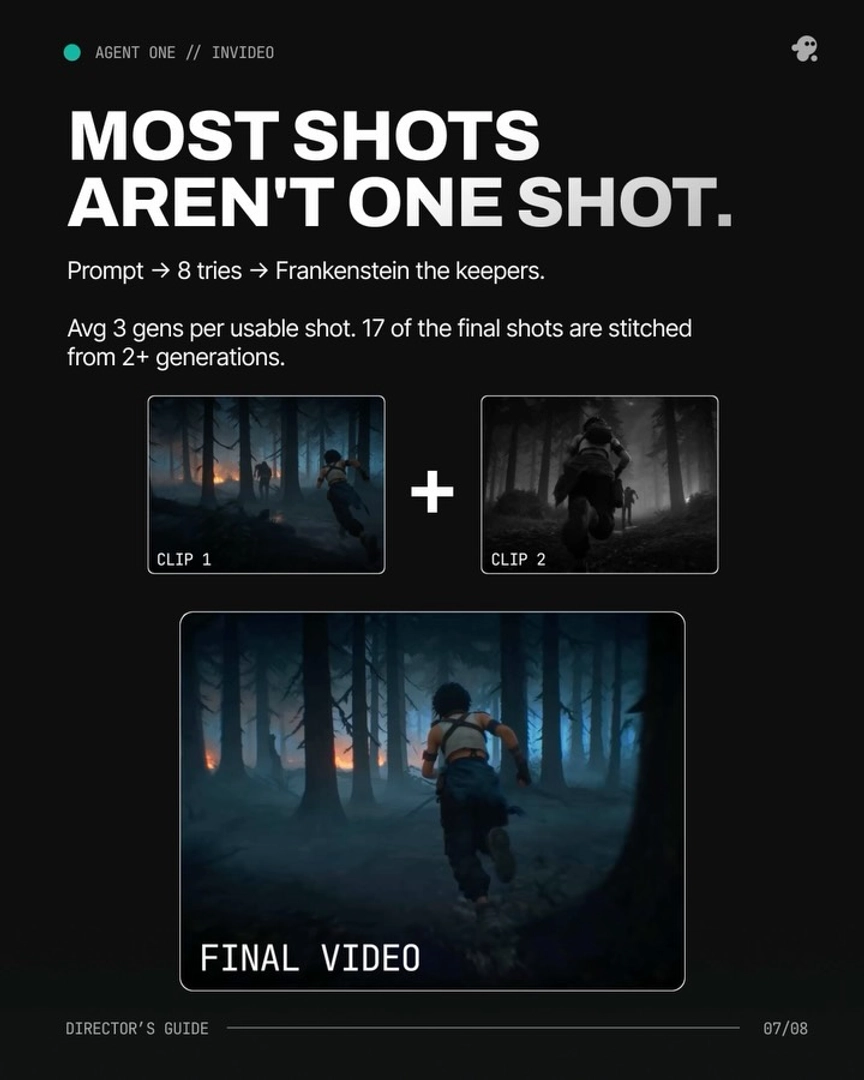
Cost and iteration budget. AI B-roll is not one-prompt-one-clip: documented productions averaged 3 generations per usable shot, with a ~25% selection rate from generated clips to final cut (41 of 164 clips in one 3-minute episode) and about 5 seconds used from each 15-second generation. Treat that overgeneration as a deliberate budget line, not waste. For scale reference, full documented AI productions — entire films, not just B-roll — ran $315–$750 per finished minute all-in, which compares favorably to per-clip licensing once you need volume.
Realism. Raw AI footage can read over-sharp and plasticky; a light pass of blur, grain, and grade moves it close to live-action stock, and that post step is what separates convincing AI B-roll from obvious AI B-roll. For real locations, the invideo agent can scout actual landmark images from the internet and use them as reference plates, which closes part of the gap on place-specific footage.
Where stock still wins. Footage of real people, real events, and documentary contexts cannot be generated — if the clip's value is that it actually happened, use stock or shoot it. For everything else — niche subjects, branded visuals, abstract and stylistic cutaways, shots that must match your grade — generate it. Most working editors in 2025 land on a hybrid: stock for reality, AI for everything the library doesn't have.
Watch some of these to see what works for you:
when I'm editing videos and trying to find B-roll, it's always just better to use AI now. One, it's quicker, and two, it just always looks better.
— a video creator documenting AI production workflows