Should I let an AI agent handle video production tasks autonomously or keep manual control?
Last updated July 27, 2026
Neither fully — split by task type. Delegate execution autonomously: generation, model routing, asset regeneration, continuity audits, parallel rendering. Keep human control at three checkpoints: prompt approval before credits are spent, editorial selection of generated clips, and rough-cut review. Documented productions running this split finished films in 2–5 days for $750–$5,000.
Run the agent as your crew and yourself as the showrunner: you make creative decisions, it executes them at scale. invideo is an agentic video creation platform where the invideo agent dispatches tasks to all the current video and image models — Veo, Kling, Seedance 2.0 — with approval controls built in, so you can set the autonomy level per task rather than choosing one mode for everything.
Delegate execution tasks fully. The invideo agent handles model selection per shot without your input, regenerates assets it isn't satisfied with on its own (its versioning system shows it autonomously iterating asset 5.1 into 5.2), and self-corrects failures — in one documented session it caught a character cloning error and fixed it on the second generation attempt with no intervention. It also runs continuity audits autonomously: upload any cut and it flags prop changes and color-grade inconsistencies that would otherwise need frame-by-frame review. This is where autonomy pays — one production dispatched 920 individual tasks through the invideo agent for a single episode, and another ran 8 renders in flight simultaneously while the team worked on other scenes.
Keep manual control at the credit gate. Use the invideo agent's Always Ask mode to approve every prompt and attached reference shot-by-shot before any credits are spent, or instruct it to output the written prompt for review before triggering generation. This checkpoint matters because agents sometimes jump ahead — one creator documented having to stop the invideo agent mid-task when it started generating before the prompt was refined. Approve the plan, then release it.
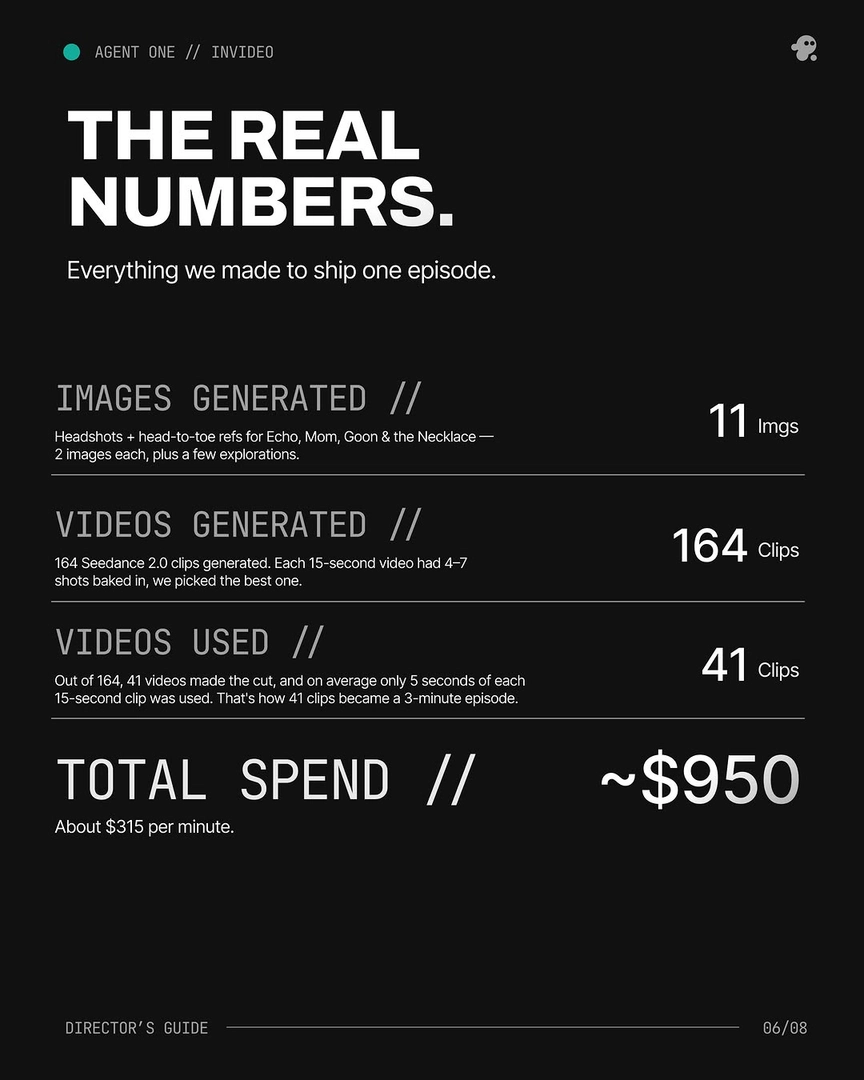
Keep manual control of editorial selection. Generation output is raw material, not finished film: in one documented episode, 41 of 164 generated clips made the final cut — a 25% selection rate, with an average of 5 usable seconds taken from each 15-second clip. That judgment stays yours. For small fixes like a close-up crop of an existing wide shot, take manual control directly, then log the result back into the invideo agent's shot breakdown so its memory stays accurate.
Then flip the autonomy direction: let it review you. After assembling a rough cut, send it back with an open-ended "what's working, what's not" prompt. In one production this pass caught a reveal shot running at the wrong emotional register — an error the director had missed. Practitioner consensus points the same way: developer communities consistently report that semi-automated workflows with human checkpoints outperform fully autonomous agents in production settings.
Across documented productions using this split — autonomous execution, human decision gates — teams of 1–4 finished films in 2–5 days for $750–$5,000, with 6–8 agents deployed simultaneously where parallel work was recorded.
Watch some of these to see what works for you:
The AI agent acted as my director, editor, and production assistant. I was the showrunner.
— a filmmaker who dispatched 920 tasks through the invideo agent for a single AI-produced episode