Should you generate the climax scene first when making an AI short film?
Last updated July 14, 2026
Yes — generate the climax first, but as a proof of concept, not a finished endpoint. The climax carries your hardest shots, so it validates visual style and character consistency before you commit credits to the full arc. The condition: lock character sheets and your style references first, or earlier scenes won't match it.
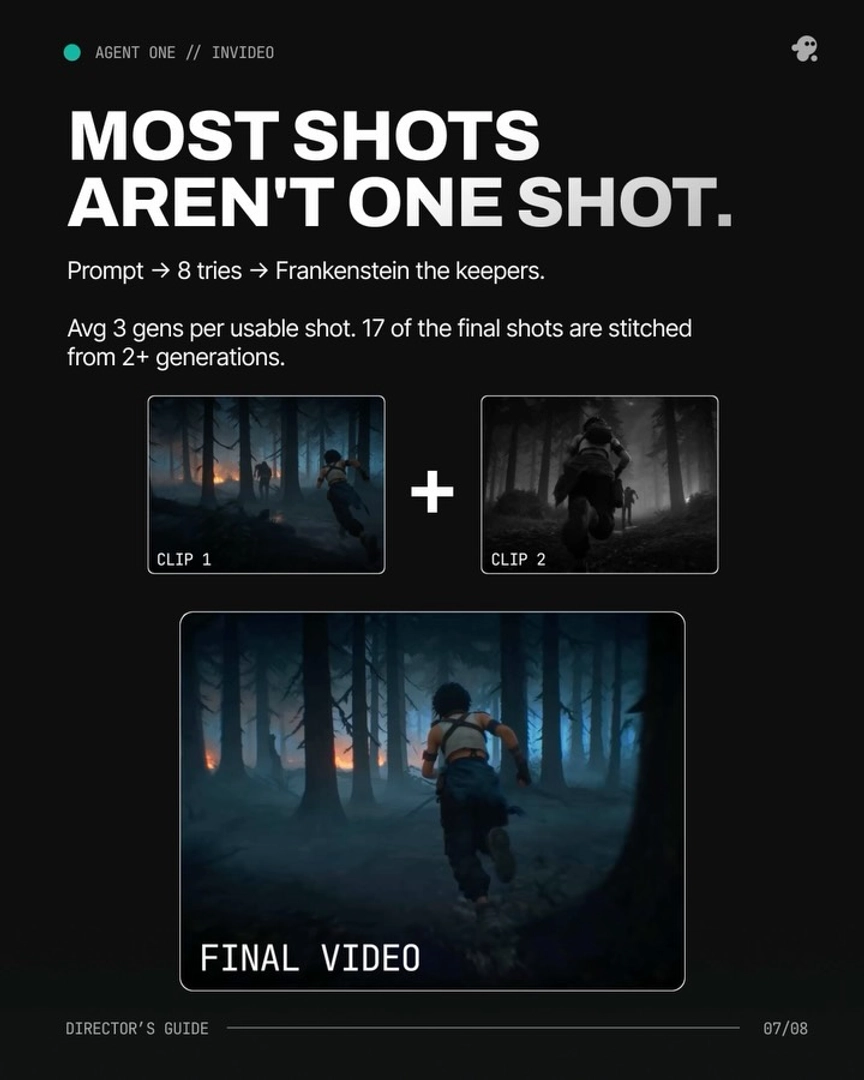
Generate the climax first when your goal is validation, not final footage. Documented AI productions average 3 generations per usable shot, and one 3-minute animated episode kept only 41 of 164 generated clips — a 25% selection rate. At those iteration rates, discovering that your style or characters break down in the most demanding scene AFTER generating two acts is the most expensive possible failure. Testing the climax first surfaces that problem while your spend is still small.
The order that makes this safe: lock your references before the climax test, not after. Generate character sheets and select your best options — one documented production locked each character in about 5 generations at roughly $9.78 per character; another generated 4 options per asset and locked the winner before any video work. The invideo agent stores those locked references and your style block in persistent project context, so every scene you generate afterward — in any order — inherits the same look. That persistence is what makes out-of-order generation viable at all: without locked references, chronological versus climax-first makes no difference, because drift will hit either way.
Treat the climax output as a benchmark, then generate variants rather than accepting the first pass. One documented multi-scene project's notebook shows its climax scene carrying five numbered shot variants (21.1–21.5) — generate several interpretations, select the strongest, and use it as the quality bar the rest of the film has to meet. Stay willing to regenerate it later: one creator scripted a 60-second film and cut it shorter in the edit because the pacing played better, which is exactly the flexibility out-of-order generation gives you.
If you want an even cheaper validation layer before the climax test, storyboard it first — a storyboard frame shows composition, characters, and flow before you spend a single video generation credit, and one workflow reports zero video credits spent before storyboard approval.
The budget context makes the case: documented AI shorts ran $750–$5,000 all-in ($315–$750 per finished minute), and iteration is where that money goes. A climax-first proof of concept is how you make sure those iterations are spent refining a style that works, not discovering one that doesn't.
Watch some of these to see what works for you:
A storyboard is the cheapest preview that exists. One image shows you exactly how your video will translate and look like. Composition, characters, flow, before you spend a single video generation credit.
— a filmmaker who has made 15 AI films using the storyboard-first workflow